

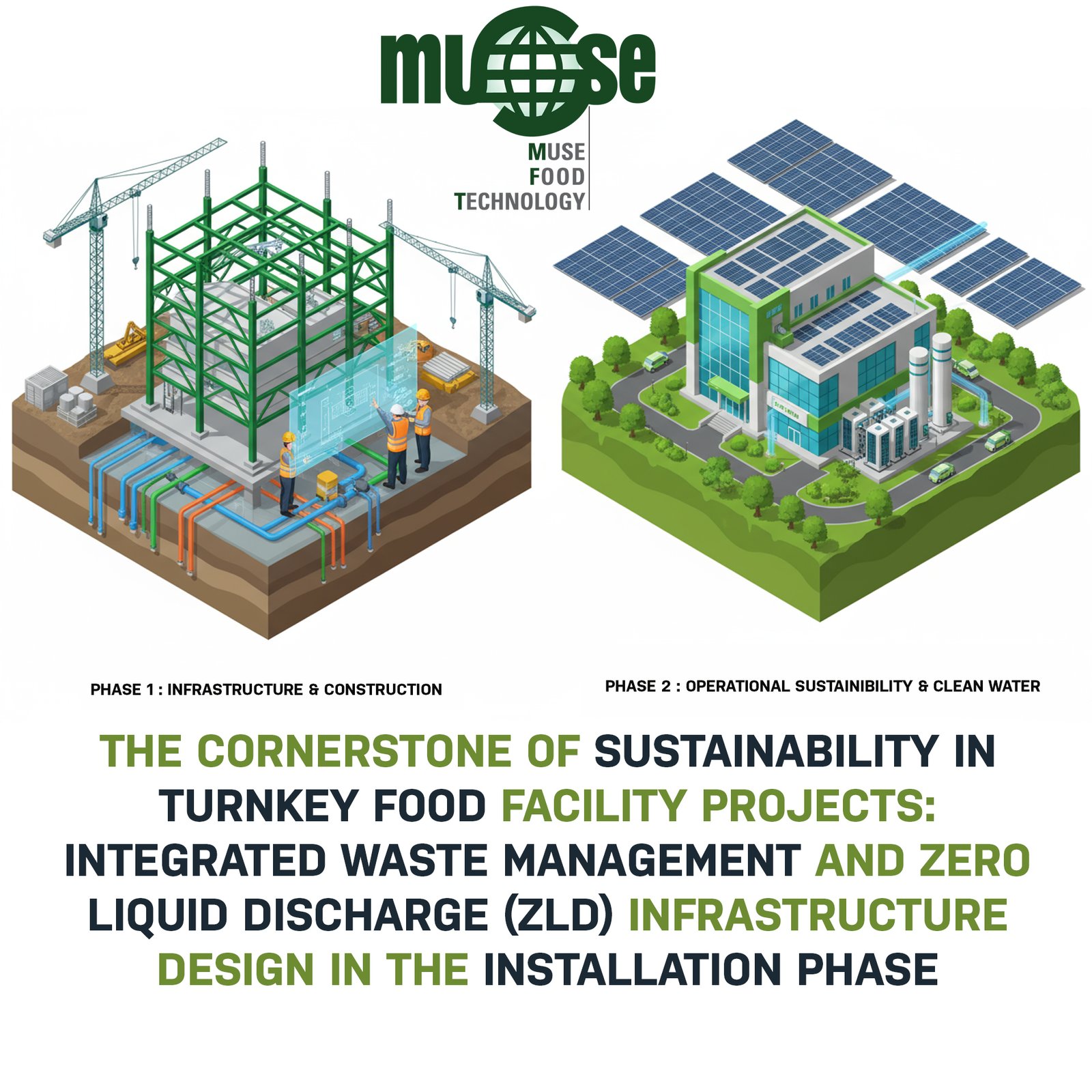
The Cornerstone of Sustainability in Turnkey Food Facility Projects
Integrated Waste Management and Zero Liquid Discharge (ZLD) Infrastructure Design in the Installation Phase
Turnkey projects aim to deliver a completed and operational facility to the end-user. Ensuring sustainability in such projects begins not during the operational phase, but in the earliest stages of installation. This article focuses on how the infrastructure for future wastewater and solid waste management should be projected, designed, and built while a factory or facility is still under construction. It particularly highlights the critical role of laying the foundations for integrated waste management strategies and Zero Liquid Discharge (ZLD) systems in terms of long-term environmental compliance, operational efficiency, and economic feasibility.
The Importance of Proactive Design
The traditional approach is to consider waste management systems after the factory is built, sometimes even after waste problems arise. This “reactive” model often leads to inefficient, inadequate, and high-cost solutions. In a turnkey project, however, the start of engineering and construction offers a unique opportunity to embed sustainability into the project’s DNA. This proactive approach ensures:
-
Optimized Layout: The optimal location for waste treatment units, process lines, and solid waste collection areas is integrated into the master plan.
-
Cost Savings: The costs of retrofitting after construction are significantly higher compared to systems integrated from the beginning.
-
Scalability and Expansion Capability: Future capacity increases are anticipated in the initial design, allowing systems to be planned accordingly.
-
Regulatory Compliance Guarantee: The project is already compliant with local and international environmental regulations upon completion.
Building Integrated Waste Management Infrastructure during the Installation Phase
Waste management is based on the principle of “managing at the source,” not “disposing of what emerges in the end.” During the installation phase, this principle is implemented through the following steps:
1. Waste Characterization and Scenario Analysis:
Even before the factory exists, a detailed waste characterization is performed based on the process design.
-
Wastewater: Modeling which processes will generate wastewater, including its chemical composition, flow rate, and temperature (e.g., oily water, wastewater containing heavy metals, high-COD organic wastewater, acidic/alkaline streams).
-
Solid Waste: Classification of construction waste, packaging waste, process residues, and hazardous wastes (oily rags, chemical waste, etc.).
2. Design and Construction of Physical Infrastructure:
-
Separated Wastewater Collection Networks: Separate sewer lines (e.g., oily water line, chemical waste line, general wastewater line) are laid within the factory to collect wastewaters of different contamination levels without mixing them. This significantly increases treatment efficiency and reduces costs.
-
Waste Collection and Temporary Storage Areas: Designated, sealed-base, covered waste collection areas for recycling, disposal, and recovery are integrated into the project master plan. Special safety measures (fire suppression, spill containment basins) are taken for hazardous wastes.
-
Underground and Above-Ground Tanks: Foundations for necessary concrete or steel tanks for chemical storage, neutralization, and pre-treatment are laid, and connection lines are installed.
Foundations for Zero Liquid Discharge (ZLD) Systems during Installation
ZLD is a process where pollutants in wastewater are separated through physical and chemical processes, with the recovered water being reused and the remaining concentrated waste minimized and disposed of. Establishing the foundation for ZLD during the installation phase requires the following components:
1. Pre-Treatment and Neutralization Units:
-
During construction, the physical infrastructure for lime beds or acid/alkali dosing tanks is created to adjust wastewater pH.
-
Concrete basins or foundations for package units for oil-grease removal (API separators, DAF units) are constructed.
2. Infrastructure for Membrane Systems:
-
The heart of ZLD consists of Reverse Osmosis (RO), Nanofiltration (NF), and Ultrafiltration (UF) systems, which require high-pressure pumps and piping. Robust, vibration-free concrete foundations and suitable electrical infrastructure for this equipment are prepared during the installation phase.
-
Piping for necessary water and chemical feed lines for membrane cleaning (CIP – Clean-in-Place) units is installed.
3. Integration of Evaporators and Crystallizers:
-
Evaporators and crystallizers, which treat the concentrated wastewater from membrane systems, are equipment that consume significant energy and require steam/cooling water.
-
During the installation phase, the area design for placing this equipment, the necessary infrastructure for steam lines and cooling towers, and heavy-load lifting systems are planned and constructed. The foundations for this equipment are designed considering vibration and load analyses.
4. Recovered Water Distribution Network:
-
A separate “reclaimed water network” is constructed to reuse the high-quality water (permeate) from the ZLD system as process water, cooling tower feed water, or cleaning water within the factory. This dramatically reduces main water consumption and costs.
Technical Challenges and Engineering Solutions
-
Corrosion Resistance: Due to high salt and chemical concentrations in ZLD processes, materials with high corrosion resistance (HDPE, FRP, duplex stainless steel, titanium coatings) must be used for pipes, tanks, and equipment.
-
Energy Optimization: ZLD systems are energy-intensive. During the installation phase, the integration of energy efficiency technologies, such as heat recovery from evaporators (MVR – Mechanical Vapor Recompression or TVR – Thermal Vapor Recompression), must be planned.
-
Concentrated Waste Management: Planning for the necessary area and logistics for the disposal of solid waste (salt, sludge) from the evaporator/crystallizer output must be done. If possible, the potential for recovering value from this waste (precious metals, salts) should be investigated.
Recommendations
In a turnkey project, the success of sustainability depends on treating waste management and ZLD infrastructure not as an “afterthought” but as a “fundamental design parameter.” Laying these foundations while the factory is still under construction:
-
Minimizes Environmental Impact,
-
Reduces Long-Term Operational Costs,
-
Eliminates Legal Risks,
-
Strengthens Corporate Reputation and the “Green Factory” identity,
-
Maximizes Resource Efficiency (water, energy, raw materials).
Therefore, project managers, engineers, and investors should involve sustainability engineering teams in the process from the very beginning and view the investment in waste management and ZLD infrastructure not as a cost item, but as a strategic investment with returns throughout the facility’s entire lifespan.